Showing posts with label Social Good. Show all posts

Thursday, February 28, 2013

Social Media Week Miami: Welcome to Social Good 2.0


By: Kyrsten Cazas, Community and Visibility Specialist


Last Friday, I had the opportunity to accompany ThinkInk’s own Chief Visibility Officer Vanessa Horwell to Social Media Week Miami, where she participated in the “Social Good 2.0: Leveraging the Power of Social Media to Promote and Grow Your Cause” panel discussion. Vanessa, along with fellow panelists Daniella Levine of Catalyst Miami, Noel Hyatt of the Broward Education Communications Network, Elianne Ramos of Latinos in Social Media (LATISM) and panel moderator Lynn Ponder of WebCityGirls, discussed how nonprofit organizations can benefit from the power and reach of social media to effectively deliver their messages and fulfill their missions.

Take a look below at Vanessa’s responses to some of the key questions asked during the panel.

Also be sure to check out @ThinkInkPR and @ThinkTankPR for great photos and helpful tips from the panel (I was live-tweeting) and you can even watch the full panel discussion here.


How should a nonprofit pick which social media tools and channels to use?

The most important factor is identifying what kind of exposure you are giving your nonprofit and that you are accurately portraying it. Whatever you do on social media reflects your brand (yes, a nonprofit is a brand), so ensure that your engagement style matches your organization’s brand, goals and general attitude.

Also make sure you do your research, look at different social media platforms and highlight the unique characteristics they have and what they can offer your organization. This will help you map out how they can help your nonprofit grow and get more exposure.

And instead of tapping in on all channels – because there is such a thing as overexposure – find out which social media tools your target audience is using today. One way to do this is by monitoring and tracking certain keywords associated with your organization and its mission through free social media monitoring tools. Also take the time to look back at what has and has not worked for you in the past.

How do you build a strong presence on Facebook, Twitter and YouTube?

“Fishing where the fish are,” nonprofit organizations can reach their target audience by monitoring what other organizations they are following and through what platform. Once you find the right platform, be active and communicate with your ‘followers” regularly so you stay on top of their newsfeed and their minds, by:
·         Writing blog posts about topics that affect your nonprofit and those whom you serve;
·         Inviting those who have received your services to contribute guest posts telling their own personal stories;
·         Creating videos to help bring your message to life;
·         Conducting interviews and featuring those who have great stories to tell or those who play a pivotal role in your mission;
·         Sharing pictures and video from events that you’ve held;
·         Posting updates regularly to keep your presence known;
·         Asking questions to get your followers talking about your organization.

The average donation through social media increases each year.  How can a non-profit get creative with fundraising outreach in social media?

Each year the average donation given through social media increases: in 2010 it was $38, jumping to $55 in 2011 and again in 2012, to $59.

Here are some great tips for fundraising outreach using social media from a PR perspective:
        Raise more funds by keeping followers active and regularly promoting fundraising events.
        Give donors the ability to share their donation activity on their own profiles.
        Keep the process seamless; donors should be able to give with no more than three clicks from your site.
        Offer as many payment methods as you can.
        Material rewards can help drive crucial funding. For example, giving away apparel with your organization’s logo can really help market your cause.

What are 5 things nonprofits can do that they might not be aware of, such as remembering to seamlessly link offline and online efforts.

·         Don’t get overextended - Sometimes doing a little bit of everything leads to nothing being well done. Look at your resources and let that guide you as to what channels you choose.
·         Timing - Tweets or Facebook posts should be scheduled to catch people in their ‘downtime.’
·         Ask questions - If your post or tweet ends in a question mark versus a period, you can expect about five times the amount of likes, comments, shares, retweets, etc.  This is because social media isn’t about monologue - it’s about dialogue. So instead of just making a statement, ask a question and invite your audience to join a conversation.
·         Be responsive - Respond to questions, tweets, posts from followers in real time.
·         Content - Your audience may not care about your organization as much as the cause you represent, try and balance out your updates by focusing more on the cause/goals your organization is working towards.
·         An Extra Tip: Collect data - Use social media to collect email addresses through online sign-ups this will give you more contacts and show you who is truly interested in your organization and your cause.

Do you agree with Vanessa when it comes to social media and using it as a marketing tool for nonprofit organizations? Comment below with your thoughts and additional tips, we’d love to hear from you!

Friday, January 18, 2013

Avoiding the ‘Second Disaster’ - The Innovative Way that Occupy Sandy Escaped from Drowning in Donations


By: Christian Williams, Social Enterprise and Visibility Specialist 

I’ll admit it - you can enroll me in NPRAA.

National Public Radio Addicts Anonymous.

I was on my typical evening commute from the office, listening to NPR’s All Things Considered as usual, and ended up getting sucked into a story about how some charities are having to TURN AWAY donations. I was stunned to hear that many charities, especially organizations that respond to national disasters, get so overwhelmed by donations that they have to say ‘No.’

Obviously, the response of the public for their neighbors in need is something to smile about; however, too many people send items that aren’t needed. The organizations prefer cash, which can then be used to purchase the necessary materials needed to respond to the recovery efforts.

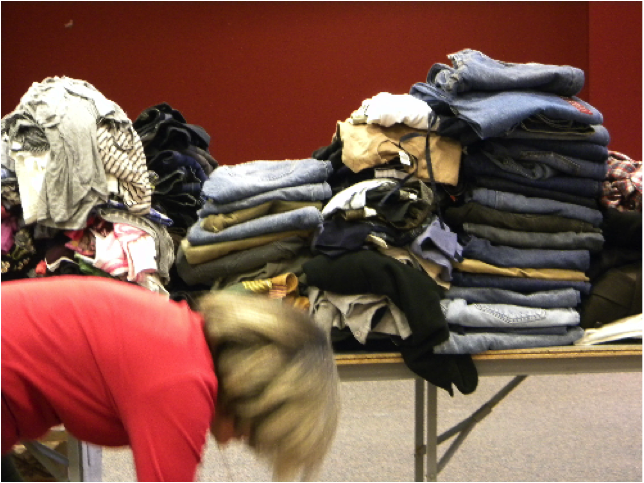
However, many donors just send clothing and other items because they think they can be used in some way (somehow, the American Red Cross ended up with a box of Frisbees).
In my opinion, some donors just see the situation as a reason to clean out their closets, all while feeling good about their decision to discard an item or two by connecting it with an urgent cause. Others want to provide items instead of money because they are skeptical of the charity and don’t want their hard-earned dollars to go misused.

I was even more surprised to hear that these piles of un-needed donations prevent needed supplies from getting to their destination on time. The story described a plane with water and food items that had to be diverted to an airport much further because the tarmac at the original airport was filled with clothes. Those supplies took an extra two days to be delivered to their final destination.

So with all of these donations flowing in, how can a responding organization avoid the ‘second disaster’? One member of Occupy Sandy, the response effort to Hurricane Sandy that stands as an offshoot of Occupy Wall Street, became an innovator when he swiped up a laptop, began an Amazon registry for the effort and listed the items needed in the effort toward recovery.

Diapers and cleaning supplies were listed. Clothes weren’t.

Donors were told that they could not send in individual items. Instead, they were directed toward the registry and told to provide the necessary funding for a concrete item needed in the effort.

And the effort worked. Occupy received all of their necessary supplies (including generators), and cut down drastically on the amount of junk by catering to their donors’ needs - the need to provide concrete assistance.

Sometimes, all it takes is a little out-of-the-box thinking to come up with the solution for a pressing problem. 

Thursday, August 23, 2012

Good Goes Social: How Panera Bread Got Customer Service Right When It Didn’t Even Have To


By Christian Williams, Social Enterprise Specialist

I’ve been a huge fan of Panera Bread for a little over a year - ever since I got hooked on their macaroni and cheese. I’ve never tried their clam chowder though (I’m not much of a clam guy), but it must be good from what I’ve heard – and just as good as a Panera Bread store manager’s idea of customer service.

Panera Bread took the Facebook community by storm earlier this month when Brandon Cook posted a story of his dying grandmother’s request for Panera’s clam chowder. The story explained his effort to get the clam chowder for his grandmother regardless of the fact that it wasn’t a Friday (the only day of the week that Panera sells clam chowder.) The young man contacted his local Panera branch and was put in touch with a manager named Sue, who went out of her way to get clam chowder to Brandon’s grandmother.

His mother, Gail Cook, soon reposted the story to Panera Bread’s Facebook page, and the story went viral from there. Since the story was posted to Panera’s page on August 8th, the post has gotten a whopping 760,263 likes.

32, 643 comments have also graced the heartwarming post. Most of the comments include an outpouring of support and well wishes for the ailing grandmother as well as many messages of thanks to the Panera Bread manager, Suzanne Fortier, for her selflessness and willingness to assist a customer in need. Many of the comments are from college-aged students like the younger Cook, which makes me even happier.

My take on it:

We all love a good news story. But when a customer goes out of their way to tell that story themselves because they were so greatly impacted by it, it means so much more. Brandon Cook didn’t need to write about his experience at Panera Bread – just like Suzanne Fortier didn’t need to go out of her way to make a single serving of clam chowder for an ailing woman.

The actions of both Brandon and Suzanne show that doing a little can do a very long way, especially when it comes to communicating good deeds through social media.

Now, every time I eat at Panera Bread, I’ll always associate the experience with feelings of kindness and the joy of one human helping another. And that feeling is addictive, just like Panera Bread’s food don’t you think?

Monday, July 30, 2012

YouTube Joins the (Social) Good Fight

By: Kyrsten Cazas, Community & Visibility Specialist

YouTube has always been a safe haven for piano-playing cats and would-be singers. But lately the Google-owned site has been rolling out quite a few upgrades aimed specifically at nonprofits.

In case you’re new to the YouTube trend, it was founded in February 2005 and allows billions of people all over the world to watch and share originally-created videos. Within the last month the video sharing site announced several new features geared to help nonprofits turn their video views into action. To start, YouTube will be holding monthly online training sessions, “YouTube 101” using Google Hangouts for members of its YouTube Nonprofit Program (a great program that provides free tools such as streaming video and fundraising capabilities). The training sessions, taking place the last Tuesday of every month, kick off July 31st at 9pm and are geared toward nonprofits new to the service. Think of them like massive videoconferencing and brainstorming sessions.

The site also announced the implementation of annotations that can link to donation websites: Change.org, DonorsChoose.org, RocketHub.com and Causes.com. An annotation is a small dialogue box that pops up in a video and allows video creators to convey messages. Videos used to only link to other videos, channels and search results. Two other annotation options were also added in April, allowing video creators to link to crowdsourcing platforms Kickstarter and Indiegogo. These annotations offer a great opportunity for nonprofits to lead viewers to sites that offer a place to donate and get more involved with the organization.  

YouTube has also released a new tool that blurs faces. The feature provides “visual anonymity” to those filmed allowing video creators to share sensitive footage without exposing those involved. One of the first of its kind, this trailblazing addition comes only a couple of months after the YouTube Human Rights channel launch. In a statement shared with Mashable YouTube said they see this as a tool to protect protesters and advocates, as well as the identities of children.

With all of the exciting opportunities available to nonprofits on YouTube, it’s no wonder their nonprofit program boasts an impressive 17,000 organizations already. Will your organization be number 17,001? Let us know what you think about YouTube’s social good efforts in your comments below.