Friday, January 18, 2013

Avoiding the ‘Second Disaster’ - The Innovative Way that Occupy Sandy Escaped from Drowning in Donations


By: Christian Williams, Social Enterprise and Visibility Specialist 

I’ll admit it - you can enroll me in NPRAA.

National Public Radio Addicts Anonymous.

I was on my typical evening commute from the office, listening to NPR’s All Things Considered as usual, and ended up getting sucked into a story about how some charities are having to TURN AWAY donations. I was stunned to hear that many charities, especially organizations that respond to national disasters, get so overwhelmed by donations that they have to say ‘No.’

Obviously, the response of the public for their neighbors in need is something to smile about; however, too many people send items that aren’t needed. The organizations prefer cash, which can then be used to purchase the necessary materials needed to respond to the recovery efforts.
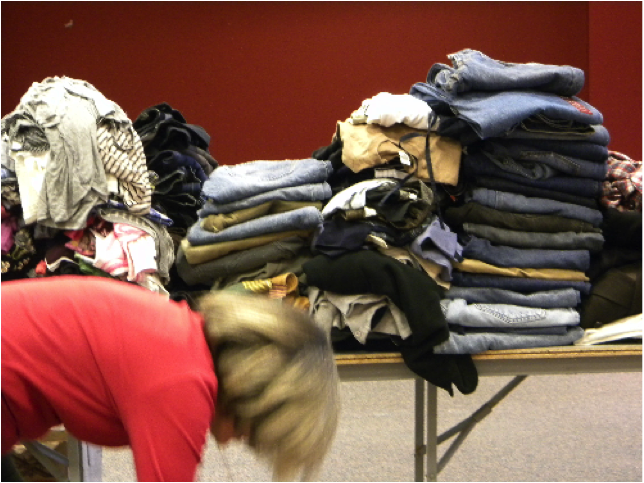
However, many donors just send clothing and other items because they think they can be used in some way (somehow, the American Red Cross ended up with a box of Frisbees).
In my opinion, some donors just see the situation as a reason to clean out their closets, all while feeling good about their decision to discard an item or two by connecting it with an urgent cause. Others want to provide items instead of money because they are skeptical of the charity and don’t want their hard-earned dollars to go misused.

I was even more surprised to hear that these piles of un-needed donations prevent needed supplies from getting to their destination on time. The story described a plane with water and food items that had to be diverted to an airport much further because the tarmac at the original airport was filled with clothes. Those supplies took an extra two days to be delivered to their final destination.

So with all of these donations flowing in, how can a responding organization avoid the ‘second disaster’? One member of Occupy Sandy, the response effort to Hurricane Sandy that stands as an offshoot of Occupy Wall Street, became an innovator when he swiped up a laptop, began an Amazon registry for the effort and listed the items needed in the effort toward recovery.

Diapers and cleaning supplies were listed. Clothes weren’t.

Donors were told that they could not send in individual items. Instead, they were directed toward the registry and told to provide the necessary funding for a concrete item needed in the effort.

And the effort worked. Occupy received all of their necessary supplies (including generators), and cut down drastically on the amount of junk by catering to their donors’ needs - the need to provide concrete assistance.

Sometimes, all it takes is a little out-of-the-box thinking to come up with the solution for a pressing problem. 

Tuesday, December 18, 2012

Heading Home for the Holidays, Albeit with Heavy Hearts


Next week, many of us will be going home for the holidays… but the occasion won’t be as festive as usual. Many families will be hurting, and we’ll be hugging our loved ones a little bit closer this holiday… especially the little ones.

What happened on December 14th in Newtown, Connecticut shocked ThinkInk staff to the core, brought tears to our eyes and served as a catalyst for anger and frustration. Regardless, all we can do right now is love our neighbors up north from afar and help out as much as we possibly can as part of the greater American family.

Which is why, this year, ThinkInk is dedicating our holiday season to giving to the victims and their families by donating to the Newtown Memorial Fund. We hope that our donation makes life a little easier for those who are grieving while having to bury their loved ones in the coming days.

Even in the face of great tragedy and in those moments where our faith in humanity falters, other people and their actions restore that faith. ThinkInk is proud to be a part of the American community, one that is reaching out to help our neighbors in Connecticut. 

This holiday season, hold your loved ones tight!

From all of us ThinkInk, we wish you and your loved ones a very safe, joyous and prosperous New Year.

Wednesday, December 12, 2012

Giving Tuesday: How Nonprofits are Leveraging Social Media to Reach Donors


By: Christian Williams, Social Enterprise and Visibility Specialist

Did you catch a #GivingTuesday tweet on your timeline during the week after Thanksgiving?

In the aftermath of the shopping ‘holidays’ of Black Friday and Cyber Monday, Giving Tuesday was a refreshing breakaway from the madness of people clamoring for hot deals from retailers across the United States. The social media movement encouraged consumers to make a difference this holiday season by donating to their favorite charities.

And guess what? It worked.

According to this infographic by MDG Advertising, nonprofits with a presence on social media networks saw a great outcome during the Tuesday campaign: a 53% increase in the amount donated on the same day in 2011. The average donation was $101, an almost-$40 increase from the average daily donation.

A visit to the movement’s website, GivingTuesday.org, provided a showcase of nonprofit partners big and small; both smaller regional organizations and huge international charities got involved in the project and ended up making a big return on their investment.

Today (on the once-in-a-lifetime calendar date of 12/12/12) in The ThinkTank’s hometown of Miami, the social giving continued locally with #GiveMiamiDay, a 24-hour giving project organized by The Miami Foundation and designed to provide funding for deserving nonprofits in the city. As of 3pm today, over $630,000 had been raised among more than 100 charities.

So why do these campaigns make such a big impact? It’s simple to explain: if you want a consumer to donate, you have to go to where they are. They are all on social media! Social platform ShareThis was mentioned in a Mashable article stating that socially shared content accounted for approximately 10% of all web content.

The ThinkTank loves nonprofits, and we’re definitely looking forward to watching the concept of social giving become bigger and better, and to see more organizations - large, tiny, local and international - hop on board. Any nonprofit that doesn’t do so risks losing out on a major opportunity not only to raise funds, but also to help others learn about their mission.
  

Monday, December 3, 2012

Giving Thanks for the Chance to Give Unused Rewards to Causes

This blog post was originally posted on KULA Causes' blog The Currency of Giving on 11/29/12. 

Thanksgiving may be over for another year but the feeling of gratitude, the desire to help others and to give back lives on at KULA and with our partner companies and their customers.

This is evident not in the Thanksgiving Thursday, Black Friday or Cyber Monday shop-a-thons, but in the millions of unused reward points and miles that are being converted by travelers into donations that benefit nonprofits all over the world.

When media has become so fixated on how much North Americans have shelled out during the four-day Thanksgiving period at brick-and-mortar outlets or online, it feels great to be contrarian and focus on how these consumers are using their points or miles to help others. It also feels great to know that we have a developed a very powerful giving engine that creates meaningful brand loyalty by connecting those consumers with the companies and causes they truly care about – all year round.

So while North Americans gave thanks then dashed out to shop last week, we continue to be grateful every day for the travelers who donate their miles and for our partners, like JetBlue and Milepoint that support the more than 2.5 millions causes available through the our CLM™ platform.

And instead of pictures of stampeding shoppers, we’ll close out with images that inspire us to be grateful.


Wednesday, November 21, 2012

Putting Profits Before People: Just How Much Bad News can Apple’s Brand Withstand?


By: Vanessa Horwell, Chief Visibility Officer

The damaging news just keeps flowing out of Foxconn’s “employee barracks” in China, where Apple’s iconic products are made.

In August 2012, the Fair Labor Association released the results of an investigation it had conducted at Apple’s request after reports of employees rioting and committing suicide over excessive work hours, inadequate compensation and unsafe working conditions.

The FLA reported that Foxconn had addressed most of the problems regulators said must be fixed, including ergonomic breaks and equipment redesign to prevent repetitive stress injuries, cutting excessive overtime hours and updating safety and equipment-testing policies.

But new trouble at Foxconn is creating yet more bad publicity for the Taiwan-based manufacturer – and for Apple.

The Economic Policy Institute reported earlier this month that the FLA’s assessment of Foxconn’s progress was too “rosy,” that high demand for the much-hyped iPhone 5 has essentially undone what few improvements have been made and gave a sharp criticism of the most valuable company in history:

“The paramount issue remains whether Apple will ever choose to apply its legendary business prowess and spirit of innovation, and its enormous financial clout, to the goal of protecting the basic human rights of the people who make those products."

Ouch.

The news comes at a time when the gadget giant is dealing with several PR hits it has taken over the past few months.
  • In early September 2012, during the run-up to the big announcement of the iPhone 5’s impending release, Forbes reported that Apple’s patent court battle with Samsung was drawing criticism even from its fans, many of whom felt Apple is filing frivolous patents and is afraid of Samsung’s competition.
  • Shortly after that the Maps debacle that left many befuddled iOS 6 users “iLost” dominated tech media for several weeks.
  • More recently, research firm Strategy Analytics released a report showing that iPhone owner loyalty is in decline, with 75% of Western European iPhone owners planning to buy their next phone from Apple, down from 88% last year. In the US, repeat purchase intentions have also declined since 2011, from 93% then to 88% now.
  • On November 8, former Apple exec David Sobotta told CNet that Steve Jobs’ successor as CEO, Tim Cook, is a technological “lightweight.”

And now there’s the latest episode in the ongoing Foxconn saga. If human rights violations continue unchecked at Foxconn, it could mean a very serious hit for Apple notwithstanding the powerful halo effect I’ve written about that seems to protect the company’s reputation and bottom line.

So I am in full agreement with the sentiment the EPI investigators expressed in closing their report. If Apple were to use its huge economic and cultural clout to force Foxconn to truly improve conditions at its Chinese factories – and I mean improvements verifiable by independent investigators, not those acting at Apple’s behest – it would not only make worker’s lives better (the most important thing), it would have the side effect of being a great PR coup for the company.

Pushing to put people before profits could protect Apple’s halo and advance its once-untarnished reputation. Will the tech behemoth put aside shareholder pressure and have the guts to do it?  I don’t think Apple will, but in this case, I would love to be proven wrong.

Thursday, November 8, 2012

The Nonprofit Post-Election Connection - An Open Letter to President Obama


By: Christian Williams, Social Enterprise Coordinator

Dear President Obama,

In your victory speech on Wednesday morning, you made a poignant statement about American unity. “… While each of us will pursue our own individual dreams, we are an American family, and we rise or fall together as one nation and as one people.” 

Nonprofits are unique in their ability as an organization to unite a politically divided public. Nonprofits influence an American culture of giving, geared to helping our nation’s citizens and companies work toward the greater good - regardless of political affiliation. We’ve already seen evidence of this in our recovery efforts for Hurricane Sandy victims.

Now that you’ve been re-elected, what will you do for nonprofit organizations?  Can you:

Influence companies to grow their corporate giving? Companies traditionally represent a huge chunk of the donations made to charities. How can you encourage companies to grow their giving programs? Can you offer tax breaks or other incentives to promote the use of employee philanthropy and volunteer programs?

Stand by nonprofit employers? Continue your support of nonprofit organizations that hire new employees by supporting them through measures like your monumental health care reform, allowing payroll tax credits to offset the cost of providing healthcare to their employees?

Continue being an example?  President Obama, you are known for being one of the most giving presidents in American history. You and Michelle contributed $172, 130 to charity in 2011, a whopping 22 percent of your adjusted income. You have even linked up with the likes of Republican talk show host Bill O’Reilly to raise money for a nonprofit organization, showing a willingness to reach across the aisle to work toward doing good.

Please continue being an example to the rest of us and encourage your fellow Americans to be as giving as you have been.

Do these things and we’ll be looking forward to another four years under your leadership.

Sincerely,
Christian Williams
The ThinkTank, Helping Nonprofits Grow

Tuesday, October 16, 2012

Greenwashing and Eco-Fatigue: Bogus Green Claims do Everyone a Disservice


By: Kyrsten Cazas, Community & Visibility Specialist

Green·wash (grēn'wŏsh', -wôsh') – verb: the act of misleading consumers regarding the environmental practices of a company or the environmental benefits of a product or service.  – TerraChoice Environmental Marketing Inc., 2007.

Last year, Britain’s Channel 4 released a documentary that investigated claims by the California-based Fiji Water company that, as a way to reduce its carbon footprint, it would plant four square miles of trees in Fiji between 2007 and 2010.

But investigators found that, as of mid-2011, the company had only planted 1.4 square miles of trees with no evident plan to fulfill its promise.

By then we’d all heard of Fiji Water, which the company touts as being “drawn from an artesian aquifer that lies hundreds of feet below the edges of a primitive rainforest” in an “isolated and idyllic setting.” Its claims of environmental friendliness and pretty illustrated bottles have landed Fiji in the hands of some much-photographed celebs, on the tables of many ritzy restaurants and even on some prime-time hit TV shows.

But plain old common sense can tell anyone that Fiji Water’s claims are dubious, at best. Fiji Water is collected on an island way out in the Pacific Ocean. Which means that it is collected thousands of miles from pretty much anywhere; the closest large market for this water, Australia/New Zealand, is, at its closest point, about 1,300 miles away. Just imagine the volume of CO₂ emissions it must take to fly and truck this stuff to, say, Manhattan, London or Miami?

An overload of green marketing – as well as an epidemic of misleadingly-labeled or marketed products (clean coal, anyone?) – has left consumers feeling the effects of eco-fatigue for several years now.

After all, how much eco-hype can a weary mass of befuddled consumers take? It doesn’t help when Stanford University tells us that much-hyped pricey organic foods – which pulled in about $29.2 billion last year – aren’t any more nutritious than regular foods, although they do reduce exposure to pesticides.

But still, this eco-fatigue is reflected in changing consumer attitudes toward “green” products.

A recent Green Gauge survey by GfK shows that 93% of consumers say they’ve changed their household behavior to save energy, but are less willing this year to pay more for products labeled as “environmentally-friendly” than they were in 2008.

So consumers have spoken and it’s going to be much harder for deceptive marketers to greenwash products. The Federal Trade Commission recently released new rules that require marketers of “green” products to back up their claims with hard data – including proof that a salient benefit isn’t canceled out by toxic aspects of production or distribution.

And it’s about time, too.

Greenwashers who deceive consumers do everyone – including their own brands, when the deception is discovered – a huge disservice. They are particularly harmful to the genuine environmental movement which is trying to address real dangers, such as the climate change, pollution and deforestation that threaten our planet – and ultimately the survival of our species.

Who feels as strongly against greenwashing as I do?  I would love to hear from you, and especially if you’ve been the victim of greenwashing.